There are over 300+ domesticated bunny breeds but the most common are the Holland lop, Lionhead, Netherland dwarf, English Angora, Flemish Giant, and Rex.
Holland Lop
The Holland Lop is a breed of lop-eared rabbit that was recognized by the American Rabbit Breeders Association (ARBA) in 1979. The Holland Lop, with a maximum weight of 1.8 kg (4 lb) (as stipulated by ARBA), is one of the smallest lop-eared breeds.
Holland Lops are one of the most popular rabbit breeds in the United States and the United Kingdom. They were first bred by Dutch breeder Adrian de Cock, as a hybrid of the French Lop and the Netherland Dwarf. Holland Lops are miniature rabbits that only weigh about 1–2 kg (2–4 lb). They are muscular in relation to their compact frame, and have a wide variety of coat colours. Their lopped ears are one of their most distinctive features.

Lionhead
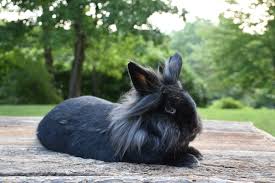
The Lionhead rabbit originated in France and Belgium; although it is not recognized by the French Federation of Cuniculture. It is reported to have been produced by breeders trying to breed a long-coated dwarf rabbit by crossing a miniature Swiss Fox and a Netherland dwarf. This resulted in a genetic mutation causing wool to appear around the head and on the flanks. This gene has come to be known as the “mane” gene. There are many other reports similar to this, for example, that the lionhead has been bred from a Netherland Dwarf and a Jersey Wooly, but none have been substantiated, since the mane gene is separate from the gene that creates wool coats in wooled rabbits. The Lionhead rabbit continued to gain popularity in Europe, and Lionheads found their way to the United States in the late 1990s.

Netherland Dwarf
The Netherland Dwarf is a breed of domestic rabbit that originated in the Netherlands. Weighing 1.1–2.5 pounds (0.50–1.13 kg), the Netherland Dwarf is one of the smallest rabbit breeds. Its popularity as a pet or show rabbit may stem from its neotenic appearance. The Netherland Dwarf is recognised by both the American Rabbit Breeders Association (ARBA) and the British Rabbit Council (BRC). The Netherland Dwarf is often confused with the Polish breed of rabbit, but the latter has longer ears, a non-brachycephalic head and less cobbiness. There are also different groups within the breed, such as: true dwarfs, false dwarfs and a group with a nickname “Peanuts”. True dwarfs have one allele for dwarfism out of the two which makes it smaller than a false dwarf, true dwarfs are the ideal Netherland dwarf. False dwarfs have zero alleles for dwarfism out of the two which makes them larger than usual. Peanuts have two alleles for dwarfism, which can only happen if you breed two true dwarfs together. This causes the rabbit to be abnormally small and often die as in nearly all cases they can not drink their mother’s milk.


English Angora
The Angora rabbit (Turkish: Ankara tavşanı) is one of the oldest groups of domestic rabbit breeds, which is bred for the long fibers of its coat, known as Angora wool. They are gathered by shearing, combing or plucking. There are at least 11 distinct breeds of Angora rabbit, four of which are currently recognized by the American Rabbit Breeders Association (ARBA): the English Angora, the French Angora, the Giant Angora and the Satin Angora. Other unrecognized breeds include the German Angora, the Finnish Angora, the Chinese Angora, the Japanese Angora, the Korean Angora, the Russian Angora, the St Lucian Angora and the Swiss Angora.
Flemish Giant
The Flemish Giant (Dutch: Vlaamse reus) is the largest breed of domestic rabbit (Oryctolagus cuniculus domesticus). Originating in Flanders and being bred potentially as early as the 16th century, the first authentic records of the breed are known from roughly 1860. Breed standards for the Flemish Giant were first written in 1893, and it is the ancestor of the Belgian Hare and Continental Giant rabbit breeds. Flemish Giants were imported to America in efforts to breed larger rabbits for meat. It became fairly popular at rabbit shows due to its large size and varying colors, and has been promoted by the National Federation of Flemish Giant Rabbit Breeders since the club’s formation in 1915.
Flemish Giant rabbits are typically docile pets and are often raised for their meat. They are often used by 4-H programs to teach children about responsibility due to their personalities and less complicated grooming needs. One individual named Alex the Great was adopted and raised as a therapy animal.
Rex
The Rex rabbit breed that is recognized by ARBA is a medium-sized rabbit with a commercial, round body and an ideal weight range of 3.4–4.8 kg (7.5–10.5 lb)] The Rex has a slightly broader head than other breeds of rabbit, proportionate upright ears, and proportionally smaller feet. As with most larger breeds, the female (or doe) has a dewlap (a large flap of skin under the chin).The Rex is a variety of rabbit that exhibits plush fur that is often described as having a velvety texture. The breed originated in France in 1919. Its origin was a litter of wild gray rabbit. and has been developed over the years by fanciers and the fur industry. The Rex Rabbit was first shown publicly at the Paris International Rabbit Show in 1924 and has been recognized as a standard breed in parts of Europe since 1925. Eugène Kohler at the University of Strasbourg developed the breed further, giving rise to colored varieties and the chinchilla rex, which is one of the main breeds used in the rabbit fur farming industry.
The Rex was first imported to the United States in 1924 following the Paris International Rabbit Show by American rabbit pioneer John C. Fehr and his partner Alfred Zimmerman.